
NHS Preceptorship
NHS preceptorship is a structured support programme designed to support the transition of newly registered healthcare practitioners from students to autonomous professionals. NHS preceptorship operates under the National Preceptorship Framework, published by NHS England in October 2022. The National Preceptorship Framework provides a standardised approach to preceptorship delivery across NHS trusts, maintaining consistency and quality in the support offered to practitioners. The framework aims to reduce early-career attrition by offering complete guidance and support, addressing a major need within the NHS employment system.
NHS preceptorship functions within the NHS Agenda for Change employment system, bridging the gap between academic training and professional practice. NHS preceptorship covers multiple practitioner groups, including newly qualified nurses, midwives, nursing associates, internationally educated nurses, and return-to-practice staff. The programme strengthens clinical confidence and competence through structured learning experiences, such as individual learning plans and clinical supervision. The National Preceptorship Framework operates on two tiers: the Core Standard and the Gold Standard, each with defined requirements for programme duration, supernumerary time, and support structures. Preceptees receive their full Band 5 salary from the start, with standard progression opportunities toward Band 6 and beyond.
What Is NHS Preceptorship?
NHS Preceptorship is a structured, time-limited programme designed to integrate newly registered healthcare practitioners into their professional teams, enhancing their clinical confidence and competence. The programme distinguishes itself from informal on-the-job learning through its formal components, which cover a named preceptor, an individual learning plan, scheduled meetings, clinical supervision and documented sign-off milestones. The structured approach keeps practitioners receiving consistent and high-quality support during their transition from student to autonomous professional.
The National Preceptorship Framework, published by NHS England in October 2022, established the first standardised structure for delivering preceptorships across NHS trusts. The framework was developed under the National Retention Programme to address early-career attrition by providing better support for new registrants entering practice. The framework's standardisation keeps all eligible practitioners, regardless of the NHS organisation they join, receiving a baseline level of structured support. The support covers protected supernumerary time, formal learning activities, regular preceptor meetings, clinical supervision and wellbeing initiatives.
What Is the Difference Between NHS Preceptorship and Mentorship?
NHS Preceptorship and mentorship are distinct forms of professional support within healthcare. Preceptorship is a structured, time-limited programme focused on building clinical competence during the transition to registered practice. It operates with formal documentation, including individual learning plans, structured meeting templates and documented sign-off milestones that mark the achievement of specific competencies. Mentorship is an ongoing, career-guidance-oriented relationship that remains informal throughout a professional's entire career. It does not rely on standardised documentation or formal assessment frameworks, allowing for a more flexible, relationship-based approach to professional guidance.
Both approaches share important elements, such as support from an experienced colleague and an emphasis on reflective practice to develop professional insight and growth. The time-limited nature of preceptorship — lasting between 6 and 12 months under the National Preceptorship Framework — stands in stark contrast to mentorship, which continues throughout an entire career span. Where preceptorship has a defined endpoint marked by formal sign-off when the preceptee demonstrates readiness for autonomous practice, mentorship evolves organically as career needs and professional relationships develop over time.
What Is the Difference Between NHS Preceptorship and Probation?
NHS Preceptorship and probation serve distinct purposes within healthcare employment. Preceptorship is a developmental support programme aimed at building clinical competence and confidence among newly registered practitioners. It keeps preceptees fully employed and receiving their complete Band 5 salary from the start, with no impact on pay or job security based on programme completion. Probation is an evaluative period assessing a new employee's suitability for a role, with potential dismissal if standards are not met. During probation, employment continuation is conditional upon satisfactory performance.
Preceptorship focuses on learning and professional growth, offering extended support if additional development time is needed. The focus contrasts with probation, where failure to meet requirements may lead to termination or an extended probationary period. The preceptorship experience at Hampshire Hospitals NHS Foundation Trust exemplifies the supportive model through regular reviews and personalised feedback, aligning with the National Preceptorship Framework's goal to enhance early-career retention.
How Long Does NHS Preceptorship Last?
NHS Preceptorship lasts for a minimum of six months under the Core Standard and extends to twelve months under the Gold Standard. The durations serve as baseline requirements rather than strict endpoints. The Nursing and Midwifery Council (NMC) emphasises that the length of preceptorship should be tailored to individual needs. According to NHS literature, preceptorship programmes range from four to eighteen months across various trusts, with most lasting between six and twelve months.
The completion of a preceptorship programme is determined by the preceptee's readiness for autonomous practice rather than a fixed calendar date. Each preceptee follows an individual learning plan, which covers regular review meetings to assess progress toward clinical competence. The approach allows for flexibility, keeping preceptees receiving adequate support to develop confidence and competence. The programme timeline begins with a supernumerary period of at least 75 hours, equivalent to two weeks, before transitioning into structured practice. The initial phase keeps preceptees able to acclimate to their new roles with the necessary support and supervision.
What Is the Supernumerary Period in NHS Preceptorship?
The supernumerary period in NHS Preceptorship is a designated phase at the programme's start where the preceptee is not counted in staffing numbers for patient care. Under the Core Standard, the period lasts a minimum of 75 hours, around two weeks, allowing preceptees time to observe and adapt without immediate clinical responsibilities. During the time, preceptees work alongside the team, familiarising themselves with clinical procedures and systems while building confidence.
The Gold Standard extends the supernumerary period beyond the Core Standard minimum, providing additional time for those who may need it, such as internationally educated nurses or return-to-practice staff. The extension supports a smoother transition into the structured programme, which covers scheduled meetings and clinical supervision. The supernumerary period matters for easing the transition from student to autonomous professional, keeping new practitioners feeling supported before assuming full clinical duties.
Who Does NHS Preceptorship Apply To?
NHS Preceptorship applies to four main practitioner groups within the National Preceptorship Framework. The groups cover newly qualified nurses and midwives, newly qualified nursing associates, internationally educated nurses and return to practice practitioners. Each group shares the commonality of being in their first period of registered clinical practice within the NHS. The shared status signifies their transition into autonomous practice, supported by structured guidance.
Newly Qualified Nurses and Midwives
Newly qualified nurses and midwives are recent graduates who have completed their initial registration. They enter the NHS workforce under the preceptorship framework to gain confidence and competence in clinical settings. The programme provides structured support through a designated preceptor, enabling them to transition smoothly into professional roles.
Nursing Associates
Nursing associates are practitioners who have completed their training and are entering registered practice for the first time. The preceptorship programme supports their integration into the NHS, focusing on developing their clinical skills and professional identity. The structured support keeps them becoming competent and confident healthcare providers.
Internationally Educated Nurses
Internationally educated nurses (IENs) are practitioners new to the UK healthcare system. The preceptorship programme aids their adaptation to NHS practices and standards. It provides a framework for recognising local protocols and expectations, keeping a smooth transition into the NHS environment.
Return to Practice Practitioners
Return to practice practitioners are individuals re-entering the professional register after a significant break from clinical work. The preceptorship programme supports their reintegration into the NHS by updating their clinical skills and knowledge. The structured support helps them regain confidence and adapt to current healthcare practices.
Newly Qualified Nurses and Midwives
Newly qualified nurses and midwives are integral to the NHS preceptorship framework. The group covers individuals who have recently completed their pre-registration nursing or midwifery education and have successfully registered with the Nursing and Midwifery Council (NMC). Eligibility for the preceptorship programme is triggered by their first registration with the NMC, marking their transition from student status to professional practice within the NHS.
The preceptorship programme specifically applies to newly qualified nurses and midwives during their initial period of registered clinical practice. It provides structured support designed to build clinical confidence and competence. The programme covers guidance from experienced preceptors, goal-setting and regular progress reviews. The support keeps the practitioners consolidating their skills and knowledge, facilitating a smooth transition into autonomous practice at the Band 5 level.
Nursing Associates
Nursing associates qualify for NHS Preceptorship as part of the National Preceptorship Framework. The structured programme supports newly registered nursing associates in their transition from trainees to autonomous practitioners within the NHS. Eligibility for preceptorship begins upon their initial registration with the Nursing and Midwifery Council (NMC), marking their entry into their first year of registered clinical practice.
The preceptorship for nursing associates mirrors the structured support given to newly qualified nurses and midwives. It covers a named preceptor, an individual learning plan, scheduled review meetings, clinical supervision and documented competency milestones. The framework matters as nursing associates develop their roles within the nursing team, working under the supervision of registered nurses while establishing their autonomous clinical practice. The programme duration adheres to the Core Standard of a minimum of six months or the Gold Standard of twelve months, providing the same supernumerary period and structured support as other eligible groups.
Internationally Educated Nurses
Internationally educated nurses (IENs) are a vital group within the NHS preceptorship framework. The nurses are qualified professionals who completed their nursing education outside the United Kingdom and have obtained registration with the Nursing and Midwifery Council (NMC) to practice in the NHS. The preceptorship programme matters for IENs as it facilitates their transition into the NHS, helping them adapt to the UK's healthcare standards and practices.
Key Elements of Preceptorship for Internationally Educated Nurses
- Eligibility and Registration: IENs qualify for NHS Preceptorship upon receiving NMC registration. The process covers demonstrating competence through assessments like the Test of Competence.
- Structured Support: The preceptorship programme offers structured support to IENs, focusing on bridging differences between international healthcare systems and the NHS. The support covers recognising local clinical protocols, documentation standards and organisational culture.
- Adaptation and Development: While IENs may arrive with significant experience, the programme recognises the need for orientation to NHS-specific practices. Trusts tailor preceptorship experiences to individual needs, sometimes offering accelerated programmes for those with extensive prior experience.
- Supervised Transition: IENs qualify for a period of supported transition, which covers supervised development and formal review processes. The transition keeps them gaining confidence and competence in their new environment before being signed off as autonomous practitioners.
The preceptorship framework for internationally educated nurses matters for keeping a smooth transition and successful integration into the NHS workforce.
Return to Practice Practitioners
Return to practice practitioners are healthcare professionals re-entering clinical practice after a significant break. The practitioners qualify for the NHS preceptorship programme, which provides structured support to facilitate their return. The programme is tailored to address their unique needs, helping them refresh skills, rebuild confidence and adapt to updated clinical practices.
The preceptorship programme for return to practice practitioners covers several key components. A named preceptor guides them through an individual learning plan, keeping specific gaps in knowledge addressed. Regular review meetings and supervised clinical practice are integral parts of the programme, confirming readiness for autonomous work. The structured support matters for navigating changes in clinical guidelines, technology and care delivery models that may have evolved during their absence.
The National Preceptorship Framework acknowledges the value of experienced professionals returning to practice. By providing tailored support, the programme reduces early attrition and keeps a smooth transition back into the NHS workforce. The approach benefits the practitioners and enhances the overall quality of care provided within the NHS.
What Is the NHS National Preceptorship Framework?
The NHS National Preceptorship Framework is the first standardised preceptorship structure published by NHS England in October 2022. The framework aims to provide consistent support for newly registered healthcare practitioners transitioning into autonomous practice. Developed under the National Retention Programme, its primary objective is to reduce early-career attrition by standardising support structures across NHS trusts. The framework aligns with the NHS People Plan and the NHS Long Term Workforce Plan, emphasising preceptorship as a core workforce development intervention rather than an optional enhancement.
The framework establishes two delivery tiers: the Core Standard and the Gold Standard. The Core Standard sets baseline requirements, including programme duration, supernumerary time, structured learning activities and documentation standards. The Gold Standard offers a more developed model with extended support and enhanced preceptor development. NHS trusts were expected to meet Core Standard requirements by September 2023, keeping a consistent level of preceptorship across services. Following the merger of Health Education England into NHS England in 2023, oversight of preceptorship became centralised under a single national body, supporting a unified approach to preceptorship delivery and quality assurance.
NHS Preceptorship Core Standard
The NHS Preceptorship Core Standard is the foundational tier that all NHS organisations are expected to deliver. It mandates a minimum programme duration of six months, beginning with a supernumerary period of at least 75 hours. During the time, preceptees work alongside their teams without being counted in staffing numbers, allowing them to focus on learning and orientation. The Core Standard needs formal structured learning activities, an individualised learning plan and regular clinical supervision sessions. It covers dedicated time for reflection and feedback, wellbeing initiatives, and pastoral care to support preceptees' mental and emotional health.
Standardised documentation supports the Core Standard, keeping consistency and quality across NHS trusts. The documentation covers a written preceptorship policy, a preceptorship charter outlining mutual expectations, structured meeting templates, development needs analysis tools, and escalation procedures for addressing concerns. While the Core Standard establishes essential support structures, it does not cover the extended features of the Gold Standard, such as additional supernumerary time, action learning and peer support.
NHS Preceptorship Gold Standard
The NHS Preceptorship Gold Standard is the aspirational tier of the NHS National Preceptorship Framework, designed to provide enhanced support for newly registered healthcare practitioners. The tier extends beyond the Core Standard by offering a more comprehensive set of requirements and support mechanisms. Key elements introduced under the Gold Standard cover an extended programme duration of 12 months, compared to the Core Standard's minimum of six months. It raises the supernumerary period, allowing preceptees more protected time to acclimate to their roles without being counted in staffing numbers.
Additional components of the Gold Standard focus on advanced support structures such as action learning sets, peer support groups, career coaching and restorative supervision. The elements aim to foster a deeper level of professional development and reflective practice among preceptees. The Gold Standard emphasises the involvement of preceptees in the design and evaluation of the programme, keeping their feedback and experiences shaping the ongoing evolution of preceptorship practices.
A distinctive feature of the Gold Standard is the introduction of the Preceptorship Champion role. The role is dedicated to promoting the value and visibility of preceptorship across the organisation. The Gold Standard limits the number of preceptees assigned to each preceptor to a maximum of two, keeping individualised attention and support. Organisations are encouraged to progress from the Core to the Gold Standard as their capacity and infrastructure develop, setting a benchmark for excellence in preceptorship delivery.
What Are the NMC Principles of Preceptorship?
The NMC Principles of Preceptorship are five core guidelines published by the Nursing and Midwifery Council in 2020. The principles establish a governance framework to keep effective preceptorship delivery across healthcare organisations. Each principle governs a distinct aspect of preceptorship, supporting newly registered practitioners in their transition to autonomous practice. Below are the principles:
- Organisational Culture and Preceptorship: The principle mandates a kind, fair and transparent environment. It builds confidence, complies with equality legislation, and prioritises health and wellbeing while embedding a culture of learning, self-reflection and safe practice.
- Quality and Oversight: The principle keeps governance frameworks in place for monitoring and evaluation. Programmes must be accessible, meet individual needs, cover various learning opportunities, and comply with local and national policies.
- Preceptee Empowerment: The principle focuses on individualised support tailored to individual needs and roles. It provides resources, reflective practice opportunities, autonomy in learning journeys, and continual professional development alongside an identified preceptor.
- Preparing Preceptors: The principle addresses the preceptor role itself, needing appropriate training and support. Preceptors should have role modelling capabilities, ongoing development opportunities, constructive feedback skills, professional guidance abilities, and facilitation of network connections.
- The Preceptorship Programme: The principle governs programme delivery, needing timely delivery that considers different routes to registration, variable length based on individual needs, a welcoming environment, agreed activities, adaptability to individual and organisational needs, and alignment with other professional development initiatives.
The principles complement the NHS National Preceptorship Framework, keeping preceptorship programmes delivering both standardised quality and individualised developmental support across all care settings and employment arrangements.
What Are the Key Roles in NHS Preceptorship?
The NHS Preceptorship framework defines four key roles: Preceptor, Preceptee, Preceptorship Lead and Preceptorship Champion. The roles are integral to the preceptorship programme, operating at both direct support and programme management levels.
Preceptor and Preceptee The Preceptor is a registered healthcare professional who provides direct support to the Preceptee, a newly registered practitioner. The Preceptor helps the Preceptee build clinical confidence and competence through structured guidance and feedback. The role needs at least 12 months of post-registration experience to keep effective mentorship. The Preceptee benefits from the structured support, transitioning smoothly into autonomous practice.
Preceptorship Lead and Champion The Preceptorship Lead coordinates the programme, keeping compliance with standards and managing resources. The role covers monitoring programme quality and reporting outcomes to senior leadership. The Preceptorship Champion, introduced under the Gold Standard tier, advocates for the programme's value and supports its integration across the organisation. Together, the Lead and Champion roles keep the programme aligned with strategic workforce goals and provide comprehensive support.
NHS Preceptor Role and Requirements
The NHS preceptor is a registered professional who directly supports the preceptee throughout the preceptorship programme. Preceptors must have at least 12 months of post-registration experience in their clinical field to keep quality guidance. Under the Gold Standard, each preceptor is limited to a maximum of two preceptees simultaneously, maintaining focused and individualised support.
Preceptors receive protected time annually to fulfil their responsibilities effectively. The Core Standard allocates a minimum of 8 hours per year, while the Gold Standard extends to 12 hours, recognising the intensive nature of quality preceptorship support. Effective preceptors demonstrate clinical competence, clear communication, and the ability to provide constructive feedback, serving as strong role models for professional behaviours and values. The qualities keep preceptees receiving consistent, high-quality guidance, aiding their transition into confident, autonomous practitioners within the NHS.
NHS Preceptorship Lead and Champion
The Preceptorship Lead is the central coordinator responsible for managing the preceptorship programme. The role covers overseeing programme delivery, keeping compliance with the National Preceptorship Framework standards, and monitoring programme quality and outcomes. The Lead reports directly to senior leadership on preceptorship effectiveness and necessary improvements. The Lead coordinates all programme logistics, maintains standardised documentation, and implements escalation procedures when preceptees need additional support.
The Preceptorship Champion is a distinct role introduced under the Gold Standard tier of the National Preceptorship Framework. The Champion acts as an advocate and promoter of preceptorship value across the entire organisation, raising awareness of the programme's benefits among staff, leadership, and stakeholders. Unlike the Preceptorship Lead, who manages operational delivery, the Champion focuses on embedding a positive preceptorship culture, encouraging organisational investment in preceptorship resources, and championing the voices of both preceptees and preceptors at strategic decision-making levels.
The organisational roles differ fundamentally from the Preceptor role — while the Preceptor provides direct, one-to-one clinical and professional support to individual preceptees through regular meetings and workplace learning, the Lead and Champion operate at the programme and strategic levels, shaping how preceptorship functions across departments and keeping the framework's principles upheld organisation-wide.
What Happens During an NHS Preceptorship Programme?
The NHS Preceptorship Programme is a structured support system designed to facilitate the transition of newly registered healthcare practitioners to autonomous professional practice. The programme begins with an initial meeting within the first two weeks, where the preceptee and preceptor establish an individual learning plan. The plan is based on a development needs analysis, identifying specific competencies to achieve and tailoring learning objectives according to the preceptee's role and clinical area.
Throughout the programme, preceptees engage in scheduled formal meetings with their preceptor, including interim reviews to assess progress against the learning plan and a final sign-off meeting upon achieving competence milestones. The Core Standard of the National Preceptorship Framework needs a minimum number of the structured meetings, while the Gold Standard recommends more frequent contact for enhanced support. Between meetings, preceptees participate in clinical supervision sessions, structured reflection and feedback activities, wellbeing support initiatives, and pastoral care. The Hampshire Hospitals NHS Foundation Trust exemplifies the model through their 12-month programme, which covers theme days with blended learning approaches, such as simulations, taught sessions, group work, e-learning, and team-building exercises.
The individual learning plan serves as a dynamic tracking tool throughout the programme, documenting competence development through regular reflection and feedback from clinical practice. Preceptees work alongside a preceptor or designated buddy who provides goal-setting guidance and conducts regular reviews to keep role compatibility and assess progression. The programme concludes with formal sign-off when the preceptee demonstrates readiness for autonomous practice, rather than at a fixed calendar date, reflecting the individualised nature of competence development. All programme activities occur while the preceptee receives their full Agenda for Change salary, emphasising the developmental nature of preceptorship over probationary evaluation.
How Does NHS Preceptorship Affect Your Pay?
NHS Preceptorship does not affect pay entitlement. Preceptees receive their full Agenda for Change salary from the first day of employment, with no reductions or conditions tied to the preceptorship programme. Unlike probationary periods in other sectors, preceptorship is a developmental framework, keeping employment status and salary independent of programme progress.
Pay during preceptorship adheres to standard Agenda for Change rules applicable to the assigned band. The pay covers band placement, at Band 5 for newly qualified nurses, midwives and nursing associates. Pay progression follows standard incremental steps based on time in post, with unsocial hours enhancements for evening, night, weekend and bank holiday shifts under Section 2 of the NHS Terms and Conditions of Service Handbook, and High Cost Area Supplements for those working in London or fringe areas. Whether completing the preceptorship in the 6-month Core Standard or extending beyond 12 months, pay progression continues unaffected. Recognising pay within preceptorship clarifies that the supportive transition programme enhances professional development without financial penalties.
What Band Do NHS Preceptees Start On?
NHS preceptees, including newly qualified nurses, midwives and nursing associates, begin their careers on Agenda for Change Band 5. The band placement is determined by the Agenda for Change Job Evaluation process, which classifies registered clinical roles based on responsibilities, required knowledge and decision-making complexity. Band 5 serves as the standard starting point across all NHS trusts in England, keeping consistent pay banding for new practitioners entering their first period of NHS employment.
What Is the NHS Preceptorship Starting Salary?
The NHS Preceptorship starting salary for newly qualified staff begins at £32,073 per annum for Band 5 positions. The salary rises up to £39,043 at the top of the band, according to the 2026/27 Agenda for Change pay scales published by NHS Employers. The figures represent the gross annual salary before deductions such as tax, National Insurance, pension contributions and student loan repayments.
NHS Preceptorship Pay With London Weighting
NHS preceptees working in London or fringe areas receive the High Cost Area Supplement (HCAS), enhancing their basic salary to accommodate higher living costs. The supplement is 20% for Inner London, 15% for Outer London, and 5% for the Fringe area, each subject to minimum and maximum annual cash caps. The supplement applies equally to preceptees as it does to all other NHS staff on the same band, keeping fair compensation adjustments from the start of their preceptorship programme.
How Does Pay Progression Work During NHS Preceptorship?
Pay progression during NHS Preceptorship follows the standard Agenda for Change incremental step points based on time in post. Preceptees advance through their band pay points via annual increments, contingent on satisfactory performance. The structure keeps preceptees receiving regular salary increases as they gain experience, mirroring the progression of other NHS staff within the same band.
Do NHS Preceptees Receive Unsocial Hours Pay?
Yes, NHS preceptees receive unsocial hours pay. Preceptees qualify for the same unsocial hours enhancement percentages as other staff within their band under Section 2 of the NHS Terms and Conditions of Service Handbook. The pay covers additional pay for shifts worked during evenings, nights, weekends and public holidays — 30% enhancement on hours between 8pm and 6am on weekdays and all day Saturday for Bands 4 to 9, and 60% for Sundays and public holidays. The enhancements are calculated by applying percentage uplifts to the basic hourly rate, following the standard Agenda for Change provisions. Preceptorship status does not affect entitlement to enhanced pay rates.
What Happens After NHS Preceptorship?
Completing NHS Preceptorship signifies the transition to autonomous practice within the healthcare system. Once preceptees finish the programme, they continue their roles with ongoing pay progression under the Agenda for Change system. The progression allows them to advance through band pay points based on tenure and satisfactory performance.
Career pathways after preceptorship vary widely, offering opportunities for specialisation, senior clinical roles, management, education and research. Many practitioners choose to develop expertise in areas like critical care or community nursing, while others pursue leadership positions or academic roles. The step marks the beginning of a professional journey with numerous options for career advancement and diversification.
How to Progress from Band 5 to Band 6 After NHS Preceptorship
Promotion to Band 6 after completing NHS Preceptorship is not automatic. It needs applying for and securing a senior or specialist role. Typical roles that carry a Band 6 designation cover senior staff nurse, specialist nurse and clinical lead positions. The roles demand greater autonomy, raised responsibility, and often cover leadership or mentoring duties.
Is NHS Preceptorship Mandatory?
NHS Preceptorship is not legally mandatory for individual practitioners. NHS England expects all NHS organisations to provide preceptorship programmes that meet at least the Core Standard requirements outlined in the National Preceptorship Framework. The framework, published in October 2022, establishes a national expectation for trusts to deliver structured preceptorship support to newly registered healthcare practitioners. Implementation varies across individual NHS organisations, with each trust designing its programme within the national framework's parameters. Individual practitioners transitioning into NHS employment will be enrolled in their trust's preceptorship programme as standard practice, reflecting the sector-wide commitment to supporting early-career retention through standardised developmental support.
Can You Fail NHS Preceptorship?
No, a preceptee cannot fail NHS Preceptorship in the traditional sense. NHS Preceptorship is a developmental support programme, not an examination or probationary period with pass/fail outcomes. If a preceptee needs additional time to develop clinical confidence and competence, they receive extended programme support rather than facing failure or dismissal. The approach aligns with the programme's core purpose under the National Preceptorship Framework — to build practitioners up through structured guidance, not to test them out of employment. The developmental nature distinguishes preceptorship from probation, keeping preceptees remaining fully employed, fully paid NHS staff throughout their journey to autonomous practice, regardless of how long that journey takes.
Does NHS Preceptorship Count Towards NMC Revalidation?
Yes, NHS Preceptorship activities contribute to NMC revalidation requirements. The structured programme covers learning activities, reflective practice sessions, and clinical supervision, all of which provide evidence for NMC revalidation. NMC revalidation is a mandatory process occurring every three years, starting from the date of initial registration with the Nursing and Midwifery Council. The process keeps nurses, midwives and nursing associates maintaining their professional standards and continuing their development.
What Is NHS Preceptorship?
NHS preceptorship is a structured, time-limited programme designed to integrate newly registered healthcare practitioners into their clinical teams. NHS preceptorship builds clinical confidence, competence, and professional identity through a structured process. Unlike informal on-the-job learning, NHS preceptorship involves formal components such as a named preceptor, an individual learning plan, scheduled meetings, clinical supervision, and documented sign-off milestones confirming readiness for independent practice.
NHS England published the National Preceptorship Framework in October 2022, marking the first nationally standardised structure for preceptorship delivery across NHS trusts. The National Preceptorship Framework was developed under the National Retention Programme to address early-career attrition, a major factor contributing to workforce turnover. The framework provides a consistent preceptorship experience, supporting retention of newly registered practitioners through structured guidance during their transition from student to autonomous professional.
What Is the Difference Between NHS Preceptorship and Mentorship?
NHS preceptorship and mentorship both provide support to healthcare professionals, but they differ in structure, duration, and focus. NHS preceptorship is a structured, time-limited programme designed to build clinical competence and confidence for newly registered practitioners. NHS preceptorship lasts between 6 and 12 months and includes formal components such as a named preceptor, individual learning plans, scheduled meetings, clinical supervision, and documented sign-off milestones.
Mentorship is ongoing, informal, and career-guidance-oriented. Mentorship does not have a fixed duration and can continue throughout an entire career. Mentorship focuses on broader career development and does not require standardised documentation or formal milestones. NHS preceptorship and mentorship share the common goal of providing support from experienced colleagues and encouraging reflective practice. The time-limited nature of NHS preceptorship contrasts with the lifelong guidance offered by mentorship, highlighting their paired roles in professional development.
What Is the Difference Between NHS Preceptorship and Probation?
NHS preceptorship and probation differ in purpose and process. NHS preceptorship is a developmental support programme designed to build clinical competence and professional confidence among newly registered practitioners. NHS preceptorship confirms that preceptees are fully employed and receive their full Agenda for Change salary from the first day, with no conditions tied to programme completion. Probation is an employment assessment period that evaluates a new employee's fitness for their role. Unsatisfactory performance during probation can lead to dismissal.
NHS preceptorship focuses on providing structured support without affecting pay or employment status. If a preceptee requires additional time to develop, NHS preceptorship extends support under the National Preceptorship Framework, avoiding disciplinary actions. Probation ties employment continuation to meeting role requirements. NHS preceptorship centres on growth and integration into the NHS workforce, while probation tests role suitability with potential employment consequences.
How Long Does NHS Preceptorship Last?
NHS preceptorship duration varies based on the tier of the National Preceptorship Framework and individual needs. The Core Standard mandates a minimum of six months, while the Gold Standard extends to a minimum of twelve months. These durations serve as baseline expectations rather than fixed endpoints, allowing flexibility to accommodate the varying development rates of preceptees.
The Nursing and Midwifery Council (NMC) states that NHS preceptorship length should be matched to the needs of each practitioner. Practices across NHS trusts indicate a range from four to eighteen months, depending on factors such as the practitioner's specialty and starting competence level. Individual learning plans, developed during initial meetings, and regular review sessions with preceptors determine when a preceptee is ready for sign-off. Readiness assessment focuses on achieving competence rather than following a set timeline.
The NHS preceptorship timeline begins with a supernumerary period, a protected learning phase where preceptees work alongside their teams without being counted in staffing numbers. The supernumerary period transitions into structured practice, marked by scheduled meetings, clinical supervision, and documented competence milestones.
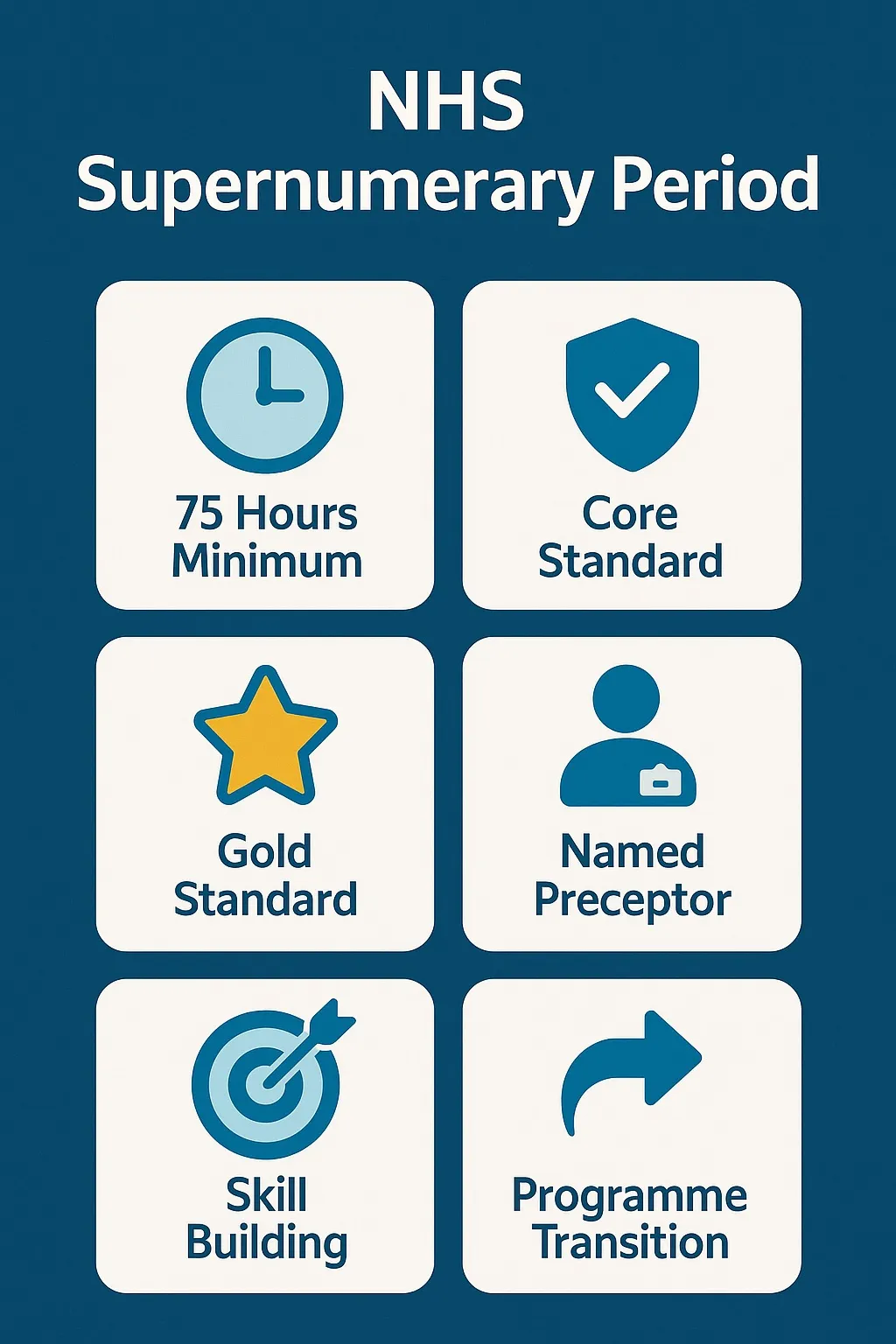
What Is the Supernumerary Period in NHS Preceptorship?
The supernumerary period in NHS preceptorship is a designated phase at the beginning of the programme where the preceptee works alongside the healthcare team without being counted in staffing numbers for patient care. The supernumerary period, defined under the Core Standard of the National Preceptorship Framework, lasts for a minimum of 75 hours, equivalent to about two weeks of full-time work. During the supernumerary period, the preceptee focuses on orientation, skill-building, and confidence development with the support of a named preceptor.
The Gold Standard of the framework extends the protected time beyond the Core Standard minimum, providing increased preparation before full integration into the clinical team. Following the supernumerary period, preceptees transition into the structured programme, which includes scheduled meetings, clinical supervision, individual learning plans, and documented milestones to support ongoing competence and professional growth.
Who Does NHS Preceptorship Apply To?
NHS preceptorship applies to four distinct groups of healthcare practitioners listed below. Each group is defined by their entry into registered clinical practice within the NHS, requiring support to transition into autonomous roles.
Newly Qualified Nurses and Midwives
Newly qualified nurses and midwives are healthcare professionals who have completed their pre-registration education and obtained registration with the Nursing and Midwifery Council (NMC). NMC registration is the key prerequisite that triggers eligibility for NHS preceptorship. NHS preceptorship supports the transition of newly qualified nurses and midwives from the academic environment into their initial roles within the NHS.
NHS preceptorship for newly qualified nurses and midwives provides structured support through several key components. Each participant receives a named preceptor who guides them through an individual learning plan matched to their development needs. The programme includes scheduled clinical supervision meetings and documented reflection activities, building clinical confidence and competence. Depending on the NHS trust's implementation level, newly qualified nurses and midwives receive support under either the Core Standard (minimum 6 months) or the Gold Standard (12 months). Newly qualified nurses and midwives receive their full Band 5 Agenda for Change salary throughout the programme.
Nursing Associates
Nursing associates are a distinct practitioner group within NHS preceptorship. Nursing associates are registered healthcare professionals who have completed a two-year Foundation Degree as a Nursing Associate and hold registration with the Nursing and Midwifery Council (NMC). NMC registration marks their eligibility for NHS preceptorship, which supports their transition into their first period of registered clinical practice within the NHS.
NHS preceptorship for nursing associates provides structured support similar to that offered to newly qualified nurses and midwives. The programme includes a named preceptor, an individual learning plan, scheduled meetings, clinical supervision, and documented sign-off milestones. NHS preceptorship builds clinical confidence and competence, supporting the transition from student to autonomous professional. Nursing associates receive their full Agenda for Change salary from the start of NHS preceptorship, with pay progression following standard rules.
Internationally Educated Nurses
Internationally educated nurses (IENs) are healthcare professionals who have obtained their nursing qualifications outside the United Kingdom. IENs enter the NHS workforce after registering with the Nursing and Midwifery Council (NMC). Despite prior experience, IENs participate in NHS preceptorship to support their transition into the NHS's distinct clinical and cultural environment. NHS preceptorship integrates IENs into NHS systems, documentation practices, and professional standards dictated by the NMC Code.
NHS preceptorship for internationally educated nurses provides structured support through a named preceptor, an individual learning plan, scheduled review meetings, and clinical supervision. The programme supports IENs in gaining confidence and competence in their new roles within the NHS. Eligibility begins upon NMC registration and the commencement of NHS employment, placing IENs on equal footing with newly qualified domestic graduates in terms of programme entitlement and salary under the standard Agenda for Change pay scale from day one.
Return to Practice Practitioners
Return to practice practitioners include registered nurses, midwives, or nursing associates who have allowed their Nursing and Midwifery Council (NMC) registration to lapse, often due to career breaks, maternity leave, or other absences. Upon completing an NMC-approved return to practice programme, return to practice practitioners regain their registration status and become eligible for NHS preceptorship. NHS preceptorship supports their transition back into registered clinical practice through a structured, time-limited support system.
NHS preceptorship for return to practice practitioners rebuilds clinical confidence and competence. The programme includes a formal individual learning plan, a named preceptor, scheduled review meetings, and clinical supervision. Programme components are designed to address identified competency gaps from the period of absence. The programme duration under the Core Standard is a minimum of six months, so that practitioners meet NMC standards for safe, effective practice.
What Is the NHS National Preceptorship Framework?
The NHS National Preceptorship Framework is the first nationally standardised structure for preceptorship delivery across NHS England. Published by NHS England in October 2022, the National Preceptorship Framework creates consistency in preceptorship programmes, which varied widely among NHS trusts before its publication. The framework was developed under the National Retention Programme to reduce early-career attrition among newly registered healthcare practitioners. The National Preceptorship Framework aligns with the NHS People Plan and the NHS Long Term Workforce Plan, positioning supported transitions into practice as a strategy for workforce retention and sustainability.
The National Preceptorship Framework establishes two distinct delivery tiers: the Core Standard and the Gold Standard. The Core Standard represents the baseline level of provision that all NHS organisations are expected to meet, including minimum requirements for programme duration, supernumerary time, structured learning, individual learning plans, clinical supervision, and pastoral care. The Gold Standard is an aspirational tier that introduces extended programme duration, additional support mechanisms, peer learning structures, and defined organisational roles such as the Preceptorship Champion. Compliance with the Core Standard was expected from all NHS trusts within a defined implementation period following the framework's publication in 2022. Progression toward the Gold Standard indicates organisational maturity in preceptorship delivery.
In 2023, Health Education England merged into NHS England, consolidating oversight of preceptorship under a single national body. The merger streamlined governance and confirmed that the National Preceptorship Framework is embedded within a unified NHS England structure responsible for both workforce planning and education standards. The consolidation reinforced the strategic importance of NHS preceptorship as a national workforce priority rather than a locally determined operational matter.
NHS Preceptorship Core Standard
The NHS Preceptorship Core Standard is the foundational tier of the National Preceptorship Framework that all NHS organisations are mandated to implement. The Core Standard provides a consistent minimum level of preceptorship support across all NHS trusts through a structured programme for newly registered healthcare practitioners. The Core Standard requires a programme duration of at least six months, starting with a supernumerary period of 75 hours, which allows the preceptee to work alongside the team without being counted in staffing numbers.
The Core Standard includes formal structured learning, an individual learning plan, clinical supervision, and mechanisms for reflection and feedback. The Core Standard incorporates wellbeing initiatives and pastoral care to support the complete development of preceptees. Standardised documentation, including a preceptorship policy, charter, meeting templates, development needs analysis tools, and escalation procedures, underpins the Core Standard for uniform implementation across organisations. The Core Standard does not extend programme duration, include additional peer support, or feature specialised roles like the Preceptorship Champion.
NHS Preceptorship Gold Standard
The NHS Preceptorship Gold Standard represents the aspirational tier of preceptorship delivery that extends beyond Core Standard requirements. The Gold Standard introduces additional features designed to strengthen support for newly registered practitioners as organisational capacity develops. The Gold Standard includes several components that expand the scope and impact of NHS preceptorship.
- Extended Programme Duration: The Gold Standard extends the programme duration to 12 months, compared to the minimum six months required by the Core Standard, allowing a full development period for preceptees.
- Extended Supernumerary Time: Beyond the Core Standard minimum of 75 hours, the Gold Standard provides additional protected time for preceptees to acclimate without being counted in staffing numbers.
- Action Learning Sets: Action learning sets support peer-based development, allowing preceptees to learn through structured group activities.
- Structured Peer Support Networks: The Gold Standard incorporates formal peer support mechanisms, strengthening the collaborative learning environment and providing additional layers of support.
- Career Coaching: Career coaching focuses on guiding preceptees in their career pathways, helping preceptees set and achieve professional goals within the NHS framework.
- Restorative Clinical Supervision: Restorative clinical supervision offers preceptees a supportive space to reflect on their practice, supporting mental well-being and professional resilience.
- Preceptee Involvement in Programme Design: Preceptees participate in shaping their preceptorship experience, embedding their feedback into programme development.
The Gold Standard introduces the Preceptorship Champion Role, a dedicated advocate responsible for advocating the value of NHS preceptorship across the trust. The Gold Standard limits each preceptor to a maximum of two preceptees, maintaining quality and personalised mentorship. NHS trusts progress from Core to Gold Standard as their organisational capacity and workforce resources develop.
What Are the NMC Principles of Preceptorship?
The NMC Principles of Preceptorship, published by the Nursing and Midwifery Council in 2020, provide a foundational governance framework to support newly registered nurses, midwives, and nursing associates. The NMC Principles confirm that preceptorship delivery meets standards across healthcare settings.
- Organisational Culture and Preceptorship: The organisational culture principle centres on creating a kind, fair, and transparent environment where preceptorship is integrated into workforce systems, allowing preceptees to feel psychologically safe and involved.
- Quality and Oversight: Governance frameworks are established under the quality and oversight principle to monitor, evaluate, and improve preceptorship delivery. Quality and oversight includes processes for identifying preceptees, maintaining preceptor capacity, and addressing system challenges.
- Preceptee Empowerment: The preceptee empowerment principle focuses on providing individualised support, resources, and opportunities for reflective practice to build confidence and competence among preceptees.
- Preparing Preceptors: The preparing preceptors principle confirms that preceptors are prepared with role modelling skills, ongoing development opportunities, and the ability to provide constructive feedback.
- The Preceptorship Programme: The preceptorship programme principle mandates that the programme be delivered in a timely manner, with variable lengths based on individual and organisational needs, including welcoming integration and agreed activities.
The NMC Principles complement the NHS National Preceptorship Framework by providing the professional and ethical foundation upon which the operational structure is built.
What Are the Key Roles in NHS Preceptorship?
The National Preceptorship Framework identifies four fundamental roles that form the backbone of NHS preceptorship: Preceptor, Preceptee, Preceptorship Lead, and Preceptorship Champion. The four roles deliver structured support to newly registered healthcare practitioners and operate at two levels: direct support and programme management.
- Preceptor: A Preceptor is a registered healthcare professional who provides direct guidance to the Preceptee. The Preceptor helps the Preceptee build clinical confidence and competence during their transition to autonomous practice. Preceptors must have post-registration experience and the ability to communicate profession-specific requirements with precision.
- Preceptee: The Preceptee is a newly registered practitioner, such as a nurse or midwife, who receives structured support through NHS preceptorship. The Preceptee focuses on developing clinical skills and confidence, supported by an individual learning plan and clinical supervision.
- Preceptorship Lead: The Preceptorship Lead acts as the central coordinator within the organisation or Integrated Care System (ICS). The Preceptorship Lead is responsible for programme coordination, evaluation, monitoring, and policy development, aligning with national standards like the NMC Principles.
- Preceptorship Champion: The Preceptorship Champion is a Gold Standard role that advocates for the value of NHS preceptorship across the organisation. The Preceptorship Champion often involves a Senior Responsible Officer (SRO) who works to advance the programme's maturity beyond Core Standard requirements.
NHS Preceptor Role and Requirements
The NHS preceptor is a registered healthcare professional who provides direct support to preceptees throughout NHS preceptorship. The NHS preceptor guides newly registered practitioners as they transition from students to autonomous professionals. Preceptors must meet a minimum post-registration experience threshold, possessing the clinical grounding to mentor colleagues. Under the Gold Standard tier, a preceptor is limited to supporting a maximum of two preceptees at the same time, which maintains the quality and consistency of guidance.
Preceptors receive dedicated protected time each year to fulfill their responsibilities. The Core Standard allocates a defined minimum of protected time for structured meetings, learning plan reviews, and feedback provision. The Gold Standard extends the allocation to accommodate more intensive programme requirements. Preceptors demonstrate clinical competence, clear communication, constructive feedback delivery, and professional role modelling.
NHS Preceptorship Lead and Champion
The Preceptorship Lead is the central coordinator responsible for managing NHS preceptorship within an NHS organisation or Integrated Care System (ICS). The Preceptorship Lead oversees programme delivery, maintains compliance with the National Preceptorship Framework standards, and reports to senior leadership. The Preceptorship Lead maintains standardised documentation, monitors preceptee progress, and confirms that both Core Standard and Gold Standard requirements are met.
The Preceptorship Champion is a distinct role introduced under the Gold Standard tier of the National Preceptorship Framework. Unlike the Preceptor, who provides direct clinical support to individual preceptees, the Preceptorship Champion advocates for the value and visibility of NHS preceptorship across the organisation. The Preceptorship Champion focuses on building a positive preceptorship culture, supporting the programme's importance, and guiding preceptors and preceptees through the benefits of structured transition support. Both roles operate at the programme management level, maintaining consistent, high-quality preceptorship delivery across all teams.
What Happens During an NHS Preceptorship Programme?
NHS preceptorship begins with an initial meeting within the first two weeks to establish an individual learning plan (ILP). The ILP maps out the preceptee's development needs, agreed learning objectives, and milestones for progression toward autonomous practice. The ILP is informed by a development needs analysis, which identifies existing competencies and areas requiring further support, producing an individualised approach rather than a one-size-fits-all process.
Throughout NHS preceptorship, the preceptee receives structured support mechanisms. Clinical supervision provides regular protected time to discuss clinical practice and decision-making with an experienced practitioner. Reflection and feedback are guided through structured reflection tools, allowing the consolidation of learning from clinical experiences, with constructive feedback provided by the preceptor. Wellbeing support and pastoral care focus on the preceptee's emotional and psychological adjustment to registered practice. Scheduled formal meetings, including an interim review and a final sign-off meeting, assess progress against the ILP. The Gold Standard recommends more frequent contact than the Core Standard minimum, reflecting a greater investment in individualised support.
NHS preceptorship concludes with a formal sign-off, reached when the preceptee demonstrates the clinical competence and professional confidence required for autonomous practice. Readiness is assessed through documented evidence gathered across the programme, including completed reflection tools, supervision records, and ILP milestone sign-offs. Every activity within NHS preceptorship occurs while the preceptee receives their full Agenda for Change salary, with no reduction or delay based on programme participation or progress.
How Does NHS Preceptorship Affect Your Pay?
NHS preceptorship does not impact a preceptee's salary entitlement. From the start of employment, preceptees receive their full Agenda for Change salary, unaffected by NHS preceptorship. Pay is neither reduced nor delayed, and no conditions are tied to completion of NHS preceptorship.
During NHS preceptorship, pay follows standard Agenda for Change rules. Newly qualified nurses, midwives, and nursing associates are placed on Band 5, with salaries starting at £29,969 per year for the 2025/26 period in England. Incremental progression within the band occurs based on time in post and satisfactory performance. Preceptees receive additional pay components such as unsocial hours enhancements and High Cost Area Supplements for those working in London and fringe areas. Pay during NHS preceptorship connects to the broader NHS Agenda for Change pay system, which includes deductions for tax, National Insurance, pension contributions, and student loans. To see your actual take-home pay after all deductions, use the NHS Pay Calculator.
What Band Do NHS Preceptees Start On?
NHS preceptees, including newly qualified nurses, midwives, and nursing associates, start on Band 5 under the Agenda for Change pay system. Band 5 assignment is determined by the Agenda for Change job evaluation process, which assesses roles based on skills, responsibilities, and qualifications required for registered clinical roles. Band 5 is the entry-level band for newly registered practitioners, providing a structured pay scale with incremental progression based on service and performance.
What Is the NHS Preceptorship Starting Salary?
The NHS preceptorship starting salary for newly qualified nurses, midwives, and nursing associates is £29,969 per year as of 2025/26 in England. The starting salary corresponds to the bottom of Band 5 under the Agenda for Change pay system. Preceptees can reach the top of Band 5 at £39,404 per year, depending on progression through incremental step points over 2 to 5 years. The salary is a gross annual figure and does not account for deductions such as tax, National Insurance, pension contributions, and student loan repayments.
NHS Preceptorship Pay With London Weighting
Preceptees working in London and fringe areas receive a High Cost Area Supplement (HCAS), which adds a percentage to their basic salary under the Agenda for Change pay system. The HCAS accounts for the higher living costs in London and surrounding regions. The HCAS applies to preceptees and all other NHS staff at the same band, maintaining consistent pay treatment across roles.
How Does Pay Progression Work During NHS Preceptorship?
Pay progression during NHS preceptorship follows the standard Agenda for Change incremental step points based on time in post. Annual increments advance the preceptee through the band pay points, contingent upon satisfactory performance. A newly qualified nurse starting at the bottom of Band 5 progresses from an entry salary of £29,969 to an intermediate step point after two years, reaching the top step point after an additional two years. Pay progression occurs independent of NHS preceptorship milestones, maintaining consistent pay advancement aligned with the Agenda for Change framework.
Do NHS Preceptees Receive Unsocial Hours Pay?
Yes, NHS preceptees receive unsocial hours pay. NHS preceptees qualify for the same enhancement percentages as all other staff at their pay band, Band 5 for newly qualified nurses, midwives, and nursing associates. Unsocial hours enhancements apply to shifts worked during evenings, nights, weekends, and bank holidays. Pay during NHS preceptorship follows standard Agenda for Change rules without restrictions, so that preceptees are compensated at the same rates as their experienced colleagues from the first unsocial hours shift worked.
What Happens After NHS Preceptorship?
Completing NHS preceptorship signifies the transition to autonomous professional practice for newly registered healthcare practitioners. Completion of NHS preceptorship confirms readiness to assume full responsibilities as registered professionals, independent of the structured oversight provided during the preceptorship period. Pay progression continues within the Agenda for Change band, advancing through incremental step points based on time in post and satisfactory performance.
Post-preceptorship, practitioners gain access to varied career development pathways within the NHS. Career opportunities include clinical specialisation in areas such as critical care, oncology, or theatre nursing, progression to senior clinical roles, movement into management and leadership positions, involvement in healthcare education, and pathways into clinical research. Practitioners build on foundational competencies developed during NHS preceptorship and pursue career trajectories aligned with their professional interests and ambitions.
How to Progress from Band 5 to Band 6 After NHS Preceptorship
Progression from Band 5 to Band 6 within the NHS is not automatic after completing NHS preceptorship. Band 6 progression requires applying for a senior or specialist role. Positions that carry a higher band include senior staff nurse, specialist nurse, and clinical lead roles.
Is NHS Preceptorship Mandatory?
NHS preceptorship is not mandatory in a legally enforced sense, but NHS England expects all organisations to provide NHS preceptorship by meeting the Core Standard requirements of the National Preceptorship Framework. The National Preceptorship Framework, established in October 2022, sets a baseline for structured support programmes aimed at retaining newly qualified practitioners. The framework includes core components like a preceptorship policy, supernumerary time, and formal learning plans that trusts are encouraged to adopt for consistent delivery. Individual NHS trusts implement NHS preceptorship with some variation in design, such as duration or additional features, while aligning with national standards and parallel principles from bodies like the NMC and HCPC.
Can You Fail NHS Preceptorship?
No, NHS preceptorship cannot be failed in the traditional sense. NHS preceptorship is a developmental support programme, not an examination or probationary period with pass/fail outcomes. NHS preceptorship focuses on building clinical confidence and competence for newly registered practitioners. If a preceptee requires additional time to meet their learning objectives, the programme provides extended support rather than resulting in failure or dismissal.
Does NHS Preceptorship Count Towards NMC Revalidation?
Yes, NHS preceptorship contributes to NMC revalidation. During NHS preceptorship, learning activities, reflective practice, and clinical supervision generate evidence that aligns with NMC revalidation requirements. NMC revalidation evidence includes supervised practice hours, reflective accounts, and feedback from preceptors. NMC revalidation operates on a three-year cycle from initial registration, enabling preceptees to use NHS preceptorship documentation, such as individual learning plans and meeting records, as verifiable evidence for their revalidation portfolio.
NHS Pay Calculator
Check your current NHS pay band, see your take-home pay after pension contributions and tax, and compare salaries across bands and regions — all in one free tool.